
A typical Ziploc bag weighs between 1 and 20 grams, depending on its dimensions, film thickness, closure design, and intended use. A lightweight snack or sandwich bag usually weighs about 1 to 2.5 grams. A quart storage bag may weigh 4 to 7 grams, while a gallon freezer bag can weigh approximately 12 to 18 grams. Slider closures, reinforced seams, and thicker freezer-grade film can increase the weight further.
These figures are practical estimates rather than universal specifications. Ziploc products and other resealable bags vary by manufacturer and product line. If bag weight affects shipping calculations, packaging compliance, or purchasing costs, you should weigh the exact bag you intend to use.
Key takeaways
- The anatomy of a Ziploc bag
- How much different Ziploc bag sizes weigh
- Factors that affect the weight of a Ziploc bag
- Why bag weight matters to consumers and businesses
- Environmental considerations
- How to choose and measure resealable bags
- Frequently asked questions about Ziploc bag weight
The Anatomy Of A Ziploc Bag
The weight of a Ziploc bag comes from three main components: the plastic film, the zipper or slider closure, and the sealed edges. The film normally accounts for most of the weight, but the closure becomes more significant on small bags and products with sliders or reinforced double seals.
“Ziploc” is a registered brand name, although the term is often used informally for resealable plastic bags. In packaging specifications, you may also see terms such as zip-top bag, zipper bag, press-to-close bag, reclosable polyethylene bag, or slider storage bag.
Materials Used
Most conventional resealable food storage bags are made from polyethylene. Manufacturers select particular polyethylene grades and blends to balance flexibility, seal strength, clarity, puncture resistance, and production cost.
- Low-Density and Linear Low-Density Polyethylene
Low-density polyethylene, commonly abbreviated as LDPE, is flexible, moisture-resistant, and suitable for heat sealing. Linear low-density polyethylene, or LLDPE, may be blended with LDPE to improve toughness and puncture resistance without making the bag excessively rigid.
These materials are widely used in food storage and general packaging bags. However, you should not assume that every sandwich bag uses only LDPE or that every freezer bag uses only one higher-density material. Commercial bags often use proprietary polyethylene blends or multilayer film structures.
- High-Density Polyethylene
High-density polyethylene, or HDPE, is stiffer than LDPE at a comparable thickness. It is common in many thin retail and food-service bags, but its use varies among resealable bag manufacturers.
A freezer bag does not necessarily weigh more because it is made entirely from HDPE. Its additional weight usually comes from increased film thickness, stronger seams, a more substantial closure, or a combination of materials designed to resist punctures and low-temperature handling.
Thickness Measured in Mils
Plastic bag thickness is often expressed in mils. One mil equals 0.001 inch, or approximately 0.0254 millimeter. A higher mil rating normally means that more plastic is used over the same surface area, which increases the weight of the bag.
Light household storage bags may be around 1 mil or slightly thicker, while freezer and heavy-duty bags can use thicker film. Industrial resealable bags are available in a much wider range, including 2 mil, 4 mil, and heavier specifications.
Thickness should not be confused with total bag weight. A small 4 mil bag can weigh less than a large 2 mil bag because the larger product has more surface area. Both dimensions and thickness must be considered.
Zipper Mechanism
A press-to-close zipper uses interlocking plastic profiles attached near the opening. These profiles are thicker than the wall of the bag, so they add weight along the top edge.
A standard zipper profile may add less than a gram to a small household bag. On larger bags, double-track zippers and reinforced opening strips can contribute more. Slider bags also include a separate plastic slider, increasing the weight compared with a similar press-to-close bag.
The closure affects more than weight. Its design influences how easily you can open the bag, remove trapped air, detect a complete seal, and reseal the package after repeated use.
Seams, Labels, and Added Features
The sides and bottom of a bag are sealed during production. Reinforced seams require additional material or wider seal areas, although their effect on total weight is usually modest.
Writable label panels, printed graphics, grip tabs, gussets, vent holes, and tamper-evident features may also change the final weight. Printing ink contributes very little on an individual bag, but every material input can matter when millions of units are produced or shipped.
How Much Do Ziploc Bags Weigh?
The weight of a Ziploc bag generally rises with its capacity and durability. Snack and sandwich bags are the lightest common formats. Storage, freezer, and slider bags weigh more because they use a larger film area, thicker material, or a heavier closure.
| Bag Type | Approximate Weight per Empty Bag | Common Uses |
|---|---|---|
| Snack bag | 1-2 grams | Crackers, fruit portions, small parts |
| Sandwich bag | 1.5-2.5 grams | Sandwiches, lunch items, lightweight storage |
| Quart storage bag | 4-7 grams | Food preparation, toiletries, craft materials |
| Gallon storage bag | 8-13 grams | Produce, meal preparation, household organization |
| Quart freezer bag | 6-10 grams | Sauces, smaller frozen portions, leftovers |
| Gallon freezer bag | 12-18 grams | Meat, bulk ingredients, complete meals |
| Gallon slider or reinforced bag | 15-22 grams | Repeated opening, heavier contents, organization |
Sandwich and Snack Bags
A standard sandwich bag commonly weighs around 1.5 to 2.5 grams. It is designed for lightweight contents and short-term storage, so it normally uses thinner film than a freezer bag.
A snack bag is smaller and may weigh approximately 1 to 2 grams. The exact relationship between snack and sandwich bag weight depends on dimensions and closure construction. A snack bag should not automatically be assumed to weigh more simply because it has a different shape.
These bags are appropriate when you need minimal packaging material and do not expect sharp edges, heavy contents, or prolonged freezer exposure.
Quart-Sized Storage Bags
An empty quart storage bag often weighs approximately 4 to 7 grams. It provides enough capacity for toiletries, small food portions, cosmetics, cables, and workshop components while remaining compact.
Travelers frequently use quart-sized transparent bags for liquids, but aviation security rules concern the bag’s capacity and closure rather than its empty weight. You should check the current requirements of the relevant airport or security authority before traveling.
Gallon-Sized Storage Bags
A gallon storage bag may weigh roughly 8 to 13 grams. Its larger dimensions require substantially more film than a sandwich bag, even if both products use a similar material.
Gallon bags work well for produce, dry ingredients, clothing accessories, meal preparation, and groups of small objects. For wet, heavy, or sharp contents, a standard storage bag may not provide enough puncture or leak resistance.
Quart and Gallon Freezer Bags
A quart freezer bag may weigh approximately 6 to 10 grams, while a gallon freezer bag often weighs 12 to 18 grams. Reinforced or slider versions may weigh more.
Freezer bags use additional material to improve resistance to punctures, handling damage, and moisture loss. Their thicker construction can also make them easier to wash and reuse when reuse is hygienically appropriate.
Bag thickness alone does not prevent freezer burn. You still need to remove excess air, close the zipper completely, maintain a stable freezer temperature, and use suitable storage periods for the food.
Factors Affecting The Weight Of Ziploc Bags
The most important factors affecting the weight of a Ziploc bag are its dimensions, film thickness, material density, closure, and additional structural features. Understanding these variables helps you compare bags that appear similar but perform differently.
1. Bag Size And Dimensions
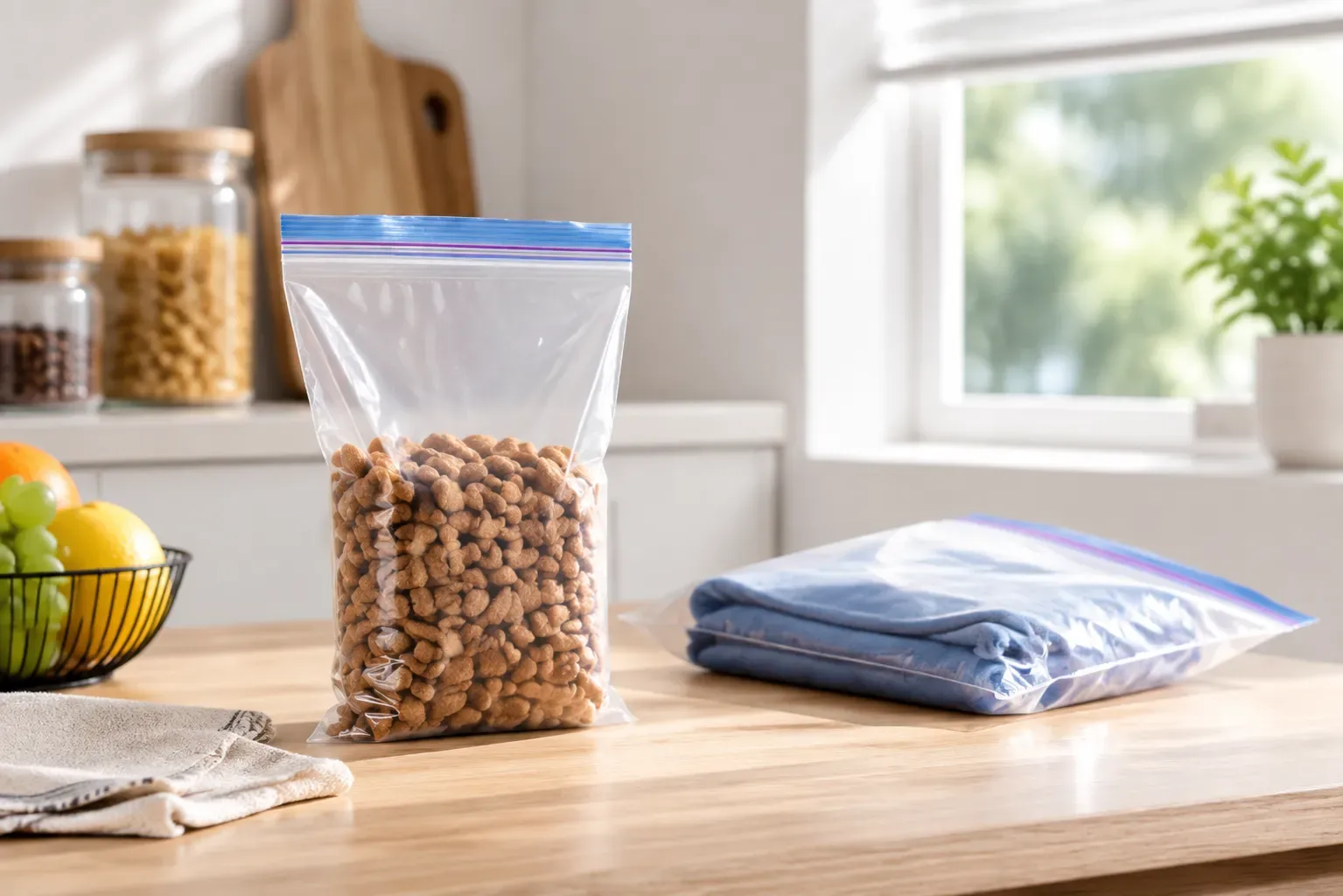
Larger bags require more film. Width and length both matter because a flat bag has a front panel and a back panel. Gussets, expandable bottoms, and stand-up structures add even more surface area.
Capacity labels do not tell the whole story. Two one-gallon bags may have different dimensions, such as a wide, shallow format and a narrow, tall format. Their film area and zipper length can therefore differ.
When ordering custom packaging, you should specify usable internal dimensions as well as external dimensions. The area above or below the zipper and the width of the sealed edges may reduce the space available for your product.
2. Material Thickness
For two bags with identical dimensions and materials, the thicker bag will normally weigh more. Increasing a film from 1.5 mil to 3 mil approximately doubles the weight of the film portion, although the zipper weight remains relatively constant.
- Products with corners or moderately sharp edges
- Liquids, sauces, or moisture-sensitive items
- Heavy parts that place stress on the seams
- Items that will be frozen or handled repeatedly
- Products requiring longer storage or transportation
Using more thickness than the application requires increases material consumption and freight weight. Using too little can cause tears, leakage, product loss, and repacking. The correct specification is based on actual handling conditions, not only the lowest unit price.
3. Plastic Resin And Film Structure
Different polyethylene grades have different densities and mechanical properties. Additives used for slip, clarity, static control, color, or processing can also affect performance and weight.
Multilayer film allows a manufacturer to combine properties from different materials. For example, one layer may support sealing while another improves toughness. A multilayer bag is not necessarily heavier than a single-layer bag; its weight depends on the total thickness and density of all layers.
If sustainability or recycling is a priority, ask whether the bag is made from a mono-material polyethylene structure. Mixed-material laminates can be more difficult to process in existing film recycling streams.
4. Closure Type
A simple press-to-close zipper is usually lighter than a slider closure. Double zippers, wide gripping tabs, audible seals, and reinforced opening strips require additional plastic.
For packaging procurement, closure convenience should be evaluated alongside weight. A slightly heavier slider may be useful for users with limited hand strength or in situations involving frequent opening. A lighter press-to-close zipper may be more efficient for single-fill or occasional-use applications.
5. Reinforced Edges And Gussets
Heavy-duty bags may include reinforced seams, thicker top sections, or bottom gussets. These features help distribute stress and increase usable volume, but they also increase material consumption.
A gusseted bag can sometimes use space more efficiently than an oversized flat bag. Therefore, a somewhat more complex structure may reduce the total packaging needed for a specific product.
6. Manufacturing Tolerances
Plastic film production is subject to normal thickness and dimensional tolerances. Two bags from the same package may not weigh exactly the same, even when they meet the manufacturer’s specifications.
This is why industrial bag weight is often expressed as an average, a nominal value, or a range. For accurate purchasing and quality control, you should weigh a sample set rather than relying on one bag.
Why Does The Weight Of A Ziploc Bag Matter?
The weight of a Ziploc bag matters because it affects material consumption, transportation costs, product protection, handling, and waste generation. For an individual household, the difference may seem small. Across commercial production and distribution, a difference of one or two grams per bag becomes measurable.
For Consumers
Bag weight gives you a rough indication of how much material is present, but it should not be used as the only measure of quality. A well-engineered lightweight film can outperform a thicker film made from a less suitable material.
For daily use, match the construction to the contents. A sandwich bag is sufficient for bread, crackers, or dry snacks. A thicker freezer bag is more appropriate for meat, sauces, and foods that will remain frozen for longer periods.
The right choice can also reduce waste. Using a gallon freezer bag for a small dry snack consumes more material than necessary. Using a thin snack bag for a heavy, wet product may result in leaks and require a second bag.
For Food Storage
Food storage bags must provide an effective closure and enough strength for the intended temperature and contents. Weight can correlate with durability, but food safety depends on more than the amount of plastic.
You should use bags intended for food contact, follow the manufacturer’s temperature instructions, and avoid placing bags in applications for which they were not designed. Some bags are suitable for freezer storage but not for boiling, conventional ovens, or direct contact with heating elements.
When storing liquids, keep the bag upright until the contents are frozen or use a rigid secondary container to reduce spill risk. Check the seal and seams before placing the bag in a crowded freezer.
For Shipping Calculations
One empty bag contributes little to a parcel’s chargeable weight. A carton containing thousands of bags is different.
To estimate total packaging weight, multiply the average weight per bag by the quantity:
Total bag weight = average weight per bag × number of bags
For example, 5,000 bags weighing 8 grams each have a combined net weight of 40,000 grams, or 40 kilograms. Cartons, labels, cores, pallets, and protective wrapping must then be added to determine gross shipment weight.
Environmental Considerations
A lighter bag generally uses less resin than a heavier bag of the same material and dimensions. That can reduce resource use and transportation emissions. However, environmental performance also depends on durability, reuse, end-of-life options, recycled content, and whether the bag prevents product waste.
Lightweight Bags Versus Durable Bags
Lightweight bags are efficient for low-risk applications. They use less material and occupy less space before use. If they tear easily in a demanding application, their material advantage can disappear through double-bagging or replacement.
Durable bags use more plastic per unit but may support repeated use. They can also prevent leakage or food loss, which may have a larger environmental impact than the packaging itself.
The better choice depends on the complete use cycle. Select the lightest bag that can reliably perform the required job.
Reusing Zipper Bags
Many resealable bags can be reused when they remain clean and undamaged. Freezer bags are often better candidates because their thicker film withstands washing and handling more effectively.
Do not reuse a bag when doing so may create a hygiene or cross-contamination risk. Bags that held raw meat, raw fish, eggs, allergens, oily substances, or spoiled food may be difficult to clean safely. Discard bags with torn film, damaged seams, persistent odors, or closures that no longer seal.
When appropriate, wash the bag according to the manufacturer’s guidance, rinse it thoroughly, and allow it to dry completely before storage.
Recycling Plastic Bags
Many flexible polyethylene bags are not accepted in curbside recycling because thin films can wrap around sorting equipment. Some communities and retailers provide separate plastic film collection programs.
Before recycling, you should:
- Confirm that local collection rules accept resealable polyethylene bags
- Remove food, paper labels, receipts, and other contaminants
- Make sure the bag is clean and dry
- Separate bags from rigid plastic recycling unless instructed otherwise
A recycling symbol identifies the type of plastic but does not guarantee that the item is accepted locally. Collection infrastructure differs by country, city, and recycling provider.
Recycled And Alternative Materials
Some resealable bags contain post-consumer or post-industrial recycled polyethylene. Recycled content can reduce demand for virgin resin, but suitability depends on food-contact rules, material consistency, appearance requirements, and local regulations.
Compostable and biodegradable claims require careful review. A bag labeled compostable may need controlled industrial composting conditions and may not break down properly in soil, water, or a landfill. It may also be unsuitable for polyethylene film recycling.
Reusable silicone bags can be a practical alternative for households that will use and wash them many times. Their higher initial material weight means the environmental benefit depends on repeated use and proper care.
How To Choose The Right Ziploc Bag Weight And Size
Choose a resealable bag by matching capacity, thickness, closure, and material to the product and handling conditions. The heaviest bag is not always the best, and the lightest bag is not always the most economical.
For Snacks And Sandwiches
Use a snack or sandwich bag for dry, lightweight foods that will be consumed soon. These bags minimize material use and fit lunch boxes efficiently.
If the food contains liquid, sharp bones, or hard edges, select a thicker storage bag or a rigid container. A heavier closure cannot compensate for film that is unsuitable for the contents.
For Freezer Storage
Use a designated freezer bag for frozen meat, prepared meals, sauces, fruit, and bulk ingredients. Choose a size that leaves enough room to close the zipper while limiting unnecessary air.
For better results, cool cooked food before bagging, remove as much air as practical, seal the bag fully, and label it with the contents and date. Freeze liquid-filled bags on a stable tray before stacking them.
For Travel And Organization
Quart and gallon storage bags are useful for toiletries, cables, hardware, office supplies, and craft components. A slider closure may be worthwhile when you will open the bag frequently.
For sharp objects, use a heavy-duty industrial zipper bag or protect the edges before packing. Household food bags are not designed to replace puncture-resistant packaging.
How To Measure The Weight Of A Ziploc Bag
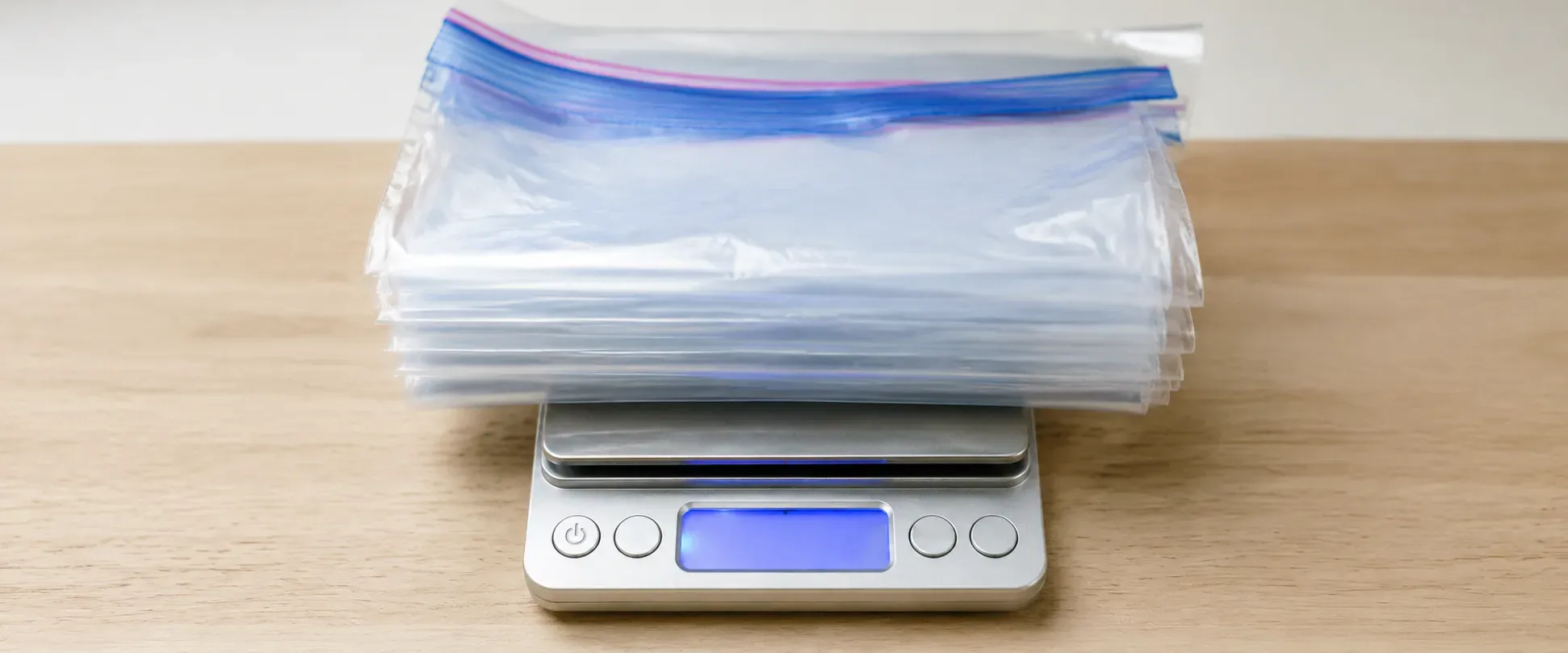
The most reliable way to determine the weight of a Ziploc bag is to weigh multiple unused bags on a calibrated gram scale and divide the total by the number of bags. Measuring a group reduces the effect of scale resolution and normal manufacturing variation.
- Place an empty container on the scale and tare it to zero.
- Count 20, 50, or 100 clean, unused bags.
- Place all counted bags in the container.
- Record the total net weight in grams.
- Divide the total weight by the number of bags.
For shipping or purchasing decisions, repeat the test with samples from several cartons or production lots. Record the sample size, product code, nominal dimensions, film thickness, closure type, and average result. This creates a more useful specification than a single informal measurement.
Frequently Asked Questions
How many grams does a sandwich Ziploc bag weigh?
How much does a gallon Ziploc bag weigh?
How much does a quart Ziploc bag weigh?
Are freezer bags heavier than regular Ziploc bags?
Does a thicker plastic bag always weigh more?
How can I weigh one plastic bag accurately?
How many Ziploc bags make one pound?
What size Ziploc bag is best for a sandwich?
Do Ziploc bags count toward food shipping weight?
Can Ziploc bags be reused?
Can Ziploc bags go in curbside recycling?
Are Ziploc bags food safe?
Does removing air change the weight of a filled bag?
What is the difference between a storage bag and a freezer bag?
Conclusion
The weight of a Ziploc bag ranges from about 1 gram for a small snack bag to more than 20 grams for a large reinforced or slider bag. Dimensions, film thickness, polyethylene formulation, zipper type, seams, and gussets all influence the final result. For households, understanding these differences helps you choose a bag that protects the contents without using unnecessary material. For businesses, accurate bag weight supports cost analysis, shipping calculations, quality control, and packaging sustainability.
Millecontainer manufactures packaging bags for food storage, retail, industrial, and organizational applications. Contact Millecontainer to discuss custom dimensions, film thickness, closure options, printing, sample testing, and order quantities. Providing your product size, filled weight, storage conditions, and distribution requirements will help our team recommend a practical bag specification.