
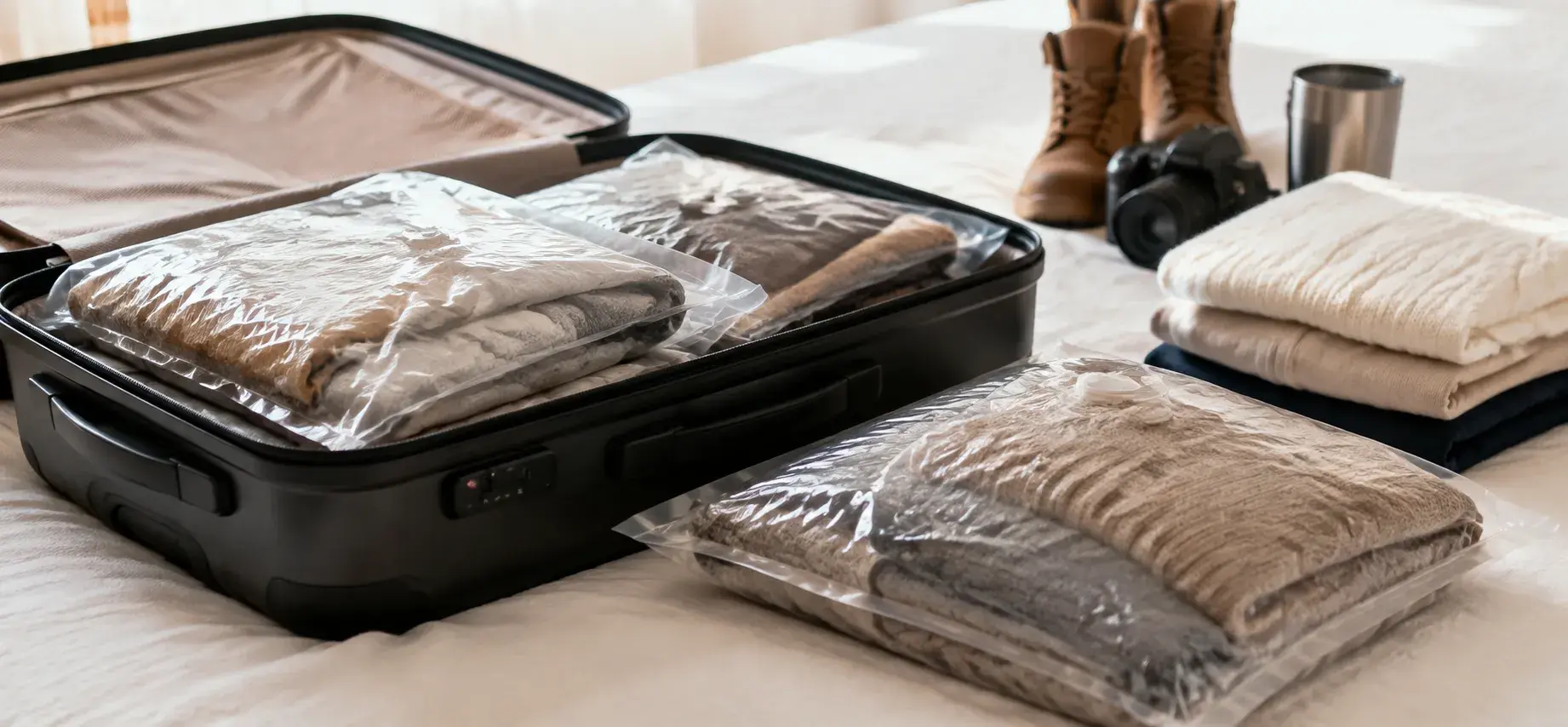
Vacuum sealed bags can make a suitcase feel much larger, especially when the trip involves winter clothing, ski layers, towels, blankets, or several people’s clothes. By removing air from soft items, a vacuum travel bag reduces bulk and keeps separate groups of clothing organized inside one case.
That space saving comes with trade-offs. Compressed clothes can wrinkle, a lighter suitcase can quickly become overweight, and a bag that depends on a large vacuum cleaner may be inconvenient when you need to repack at a hotel or airport. The best vacuum sealed bag for travel is therefore the one that matches the way you pack, the type of clothing you carry, and the equipment you can realistically access on the return journey.
This guide explains how to use vacuum sealed bags for travelling, when to compress and when not to, how to choose between electric-pump, hand-pump, and roll-up designs, and how to avoid the common packing mistakes that turn a useful bag into a difficult one.
Can You Use Vacuum Sealed Bags for Travelling?
Yes. Travel vacuum bags are designed to compress soft, flexible items so they occupy less volume in a suitcase, backpack, or duffel. They are particularly useful when the contents are bulky but not heavy, because removing air reduces the space taken by the fabric without changing the weight of the clothes.
A travel vacuum bag normally includes a flexible multilayer film, a zipper or double-seal closure, and a one-way valve. Some models use an external valve for a vacuum cleaner or electric pump. Others include a compact hand pump. Roll-up compression bags use a different approach: the traveler pushes air out through an opening while rolling the bag and then closes the seal.
The bag does not make luggage lighter. It only creates more usable volume. The final suitcase still needs to stay within the airline’s weight, size, and carry-on rules, and the bag should be easy to reopen and reseal if security staff need to inspect it.
When Are Vacuum Travel Bags Most Useful?
The strongest use case is a trip where clothing volume changes more than clothing weight. Instead of trying to make every garment smaller, group the bulky items that will benefit from compression and keep the rest of the suitcase easy to access.
- ✓Winter holidays: coats, sweaters, thermal layers, scarves, and hats occupy a large amount of space before compression.
- ✓Ski and outdoor trips: fleece, base layers, gloves, and soft technical clothing can be grouped by person or activity.
- ✓Family travel: separate each person’s clothing in a different bag so a shared suitcase is easier to organize.
- ✓Hand-luggage trips: compression can make room for a second pair of shoes, toiletries, or a small personal item, provided the final weight remains manageable.
- ✓Return journeys: dirty clothes can be compressed after they are worn, creating space for gifts, souvenirs, or items bought during the trip.
- ✓Moving between accommodations: sealed clothing groups are easier to transfer between a suitcase, locker, and wardrobe without mixing clean and worn items.
They are less useful for rigid objects, shoes with hard edges, liquids, delicate formalwear, and anything that needs to remain perfectly smooth. Compression is a space-management method, not a replacement for careful packing.
How Much Space Can a Vacuum Bag Save?
The amount of space saved depends on the fabric, how loosely it is packed, the bag’s working area, and how much air can be removed. Thick knitwear and down-filled items often compress more than jeans or tightly woven shirts. A bag can reduce bulk substantially, but the result is not a fixed percentage for every load.
Use a suitcase scale or bathroom scale before and after packing. If the bag creates enough space to add more items, the additional weight can become the real limit. A compressed suitcase that is difficult to lift, drag, or place into an overhead locker is not a successful packing solution.
| Packing Question | What to Check | Why It Matters |
|---|---|---|
| Do I need more space or less weight? | Weigh the packed case before adding new items | Compression creates volume; it does not remove mass |
| Will I open the bag during the trip? | Choose a closure and pump method that can be reused | A bag that cannot be resealed is inconvenient after inspection or laundry |
| Are the clothes wrinkle-sensitive? | Separate smooth garments from casual or washable layers | High compression can create hard folds and pressure lines |
What Is the Main Disadvantage of Vacuum Packing Clothes?
The most noticeable disadvantage is creasing. When air is removed, fabric layers are pressed tightly together and the folds created during packing can become more pronounced. Rolling clothes can distribute the folds more gently than sharp folding, but it cannot guarantee wrinkle-free results.
This is usually acceptable for underwear, T-shirts, fleece, sportswear, pajamas, swimwear, and clothing that will be washed after the trip. It is less suitable for suits, dresses, linen, delicate blouses, structured jackets, or any item that needs to look pressed immediately after arrival.
A practical compromise is to use the bag as a packing cube at the beginning of the trip and compress it only on the return journey. Dirty clothes are already headed for the wash, and the extra space can be used for souvenirs without putting formal clothes under maximum compression.
Should You Use a Vacuum Bag or a Compression Packing Cube?
A vacuum bag removes more air and produces a flatter, denser bundle. A compression packing cube uses a zipper or straps to reduce volume without removing all of the air. The better choice depends on whether maximum space or easier access and fewer creases matter more.
| Feature | Vacuum Sealed Bag | Compression Packing Cube |
|---|---|---|
| Space reduction | Higher, especially for bulky soft items | Moderate and easier to control |
| Wrinkle risk | Higher when fully compressed | Usually lower because air is not removed completely |
| Pump or equipment | May require a valve-compatible pump | No pump required |
| Best use | Winter layers, bedding, return-trip laundry, maximum capacity | Frequent access, wrinkle-sensitive clothing, everyday organization |
How To Pack Clothes in a Vacuum Sealed Travel Bag
- Choose the right bag size. The clothing should fill the working area without reaching into the zipper track or pressing against the valve. An oversized bag can leave dead space and fold unevenly.
- Group similar items. Put heavy sweaters, thermal layers, or soft sleepwear together. Keep clean and worn clothing in separate bags whenever possible.
- Remove hard and sharp objects. Shoes, buckles, chargers, cosmetics bottles, and corners of books can puncture the film or distort the valve.
- Flatten the garments. Smooth large folds and place the thickest items toward the center, away from the zipper and side seams.
- Leave closure space. Keep the top edge clean. Powder, hair, fabric fibers, and trapped clothing can prevent the zipper from closing.
- Close the zipper from one end to the other. Use the provided slider when available, then run your fingers along the track to check that it is fully interlocked.
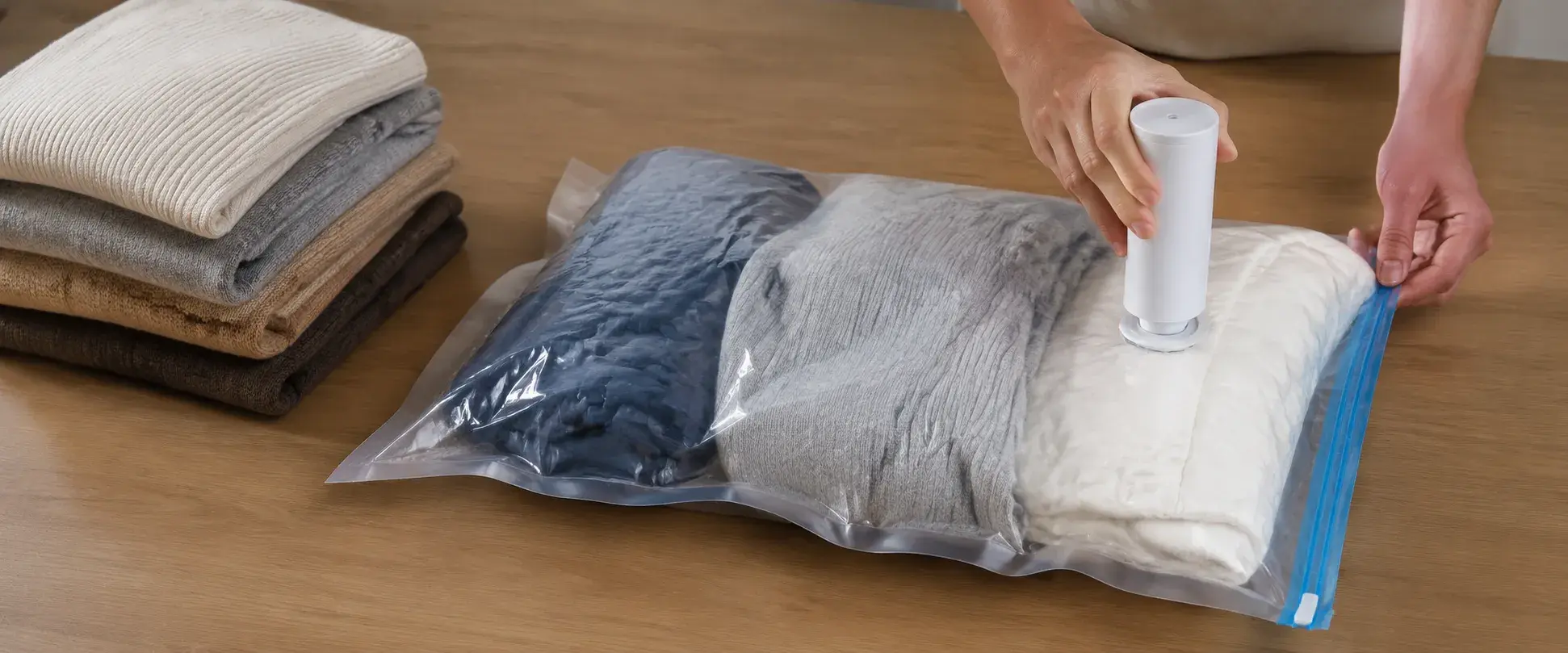
- Remove air gradually. Use the hand pump, electric pump, or roll-up method suited to the bag. Stop when the bundle is stable rather than forcing the film into a hard brick.
- Check the valve and edges. A short leak check helps identify a crooked zipper, trapped material, or a valve cap that is not seated.
Which Vacuum Bag Design Is Best for Travel?
Travel bags are usually grouped by the way air is removed. The choice affects convenience, space reduction, failure risk, and what you can do after the bag is opened.
Electric-Pump Vacuum Bags
Electric-pump systems remove air quickly and with little manual effort. They are convenient at home or in accommodation with a suitable power source. For travel, the pump should be compact, compatible with the valve, and usable with the voltage and plug arrangement available at the destination.
The limitation is dependence on equipment. A lost cable, dead battery, incompatible adapter, or pump failure can make it difficult to reseal the bag after an airport inspection. Electric systems are strongest when the traveler carries a backup compression method or does not expect to reopen the bag.
Hand-Pump Vacuum Bags
Hand-pump bags use a small manual pump that connects to the valve. They are slower than electric systems but do not depend on a wall outlet. A compact pump can be stored inside the suitcase, provided its size does not offset the space saved by compression.
The pump should create a reliable connection without damaging the valve. A universal-looking nozzle may not seal correctly on every bag. For a product line, consistent valve dimensions and a clear compatibility guide reduce frustration for travelers.
Roll-Up Compression Bags With No Pump
Roll-up bags use a one-way opening or vent path. The traveler closes the main seal partway, rolls the bag toward the opening, pushes air out, and completes the closure. They remove less air than a strong pump, but they are lightweight and do not add a device that can be forgotten or broken.
This format can be a better choice for travelers who want moderate compression, easier resealing, and fewer wrinkles. It also works as a backup when a pump-based bag has to be opened away from home.
What Should You Look for in a Travel Vacuum Bag?
| Bag Feature | Why It Matters on a Trip | What to Check |
|---|---|---|
| Film strength | Suitcases are dragged, stacked, and compressed by other luggage | Puncture resistance, seam quality, and a smooth inner surface |
| Zipper or double seal | The bag may need to be opened and closed several times | Track alignment, slider quality, and closure feedback |
| One-way valve | Controls air removal and prevents air returning during packing | Pump compatibility, cap fit, and leak resistance after compression |
| Transparent or lightly tinted film | Makes it easier to identify clothes without opening the bag | Clarity, print or label area, and resistance to scuffing |
| Multiple sizes | Different garment groups need different working dimensions | Actual usable size, not only the outside package dimensions |
Can You Use Vacuum Bags Without a Vacuum Cleaner?
Yes, but the method depends on the bag. A hand-pump bag can be compressed with its supplied pump. A roll-up bag can be compressed manually. Some valve bags also accept a small portable electric pump. A standard household vacuum cleaner may remove air quickly at home, but it is not a practical travel plan unless you know you will have access to a compatible machine.
For a return journey, choose a bag that can be resealed with equipment you can carry. If a bag can only be compressed by a large vacuum cleaner, opening it at the airport or hotel may leave you with a full-size bundle that no longer fits the suitcase.
How Do You Repack a Vacuum Bag After Airport Inspection?
- Keep the bag’s original pump, cap, slider, or roll-up closure in an easy-to-reach pocket rather than at the bottom of the suitcase.
- Remove only the bag that needs inspection. Avoid opening every compressed bundle if one bag contains the requested item.
- Place the clothes back evenly and keep fabric away from the zipper track and valve.
- Close the seal completely, then use the hand pump or roll-up method. If no equipment is available, press the bag flat and remove as much air as possible before closing it.
- Check the valve cap and run your fingers along the closure. A small leak can expand into a large bundle during the next few hours of travel.
Will Vacuum-Sealed Luggage Become Too Heavy?
It can. The bag removes air but not fabric, and the extra volume often encourages travelers to add more items. Weigh the suitcase after compression and again after adding souvenirs or shopping. Do not rely on the case feeling smaller as evidence that it is within the weight limit.
Hand luggage has an additional practical limit: you may need to lift it into an overhead compartment, carry it through a station, or move it up stairs. Even where an airline does not publish a strict cabin-bag weight, a bag that cannot be safely handled can create problems for the traveler and the crew.
What Should Not Go in a Travel Vacuum Bag?
Vacuum bags are intended for soft, dry, flexible goods. Avoid placing the following items inside unless the bag and product are specifically designed for that use:
- ✕Sharp objects, exposed buckles, tools, and hard corners that can puncture the film.
- ✕Wet clothing that needs ventilation, because trapped moisture can create odors and mildew.
- ✕Liquids or toiletries that could leak and contaminate the zipper and valve.
- ✕Delicate formal clothing that must remain smooth and ready to wear.
- ✕Items that must not be compressed, such as structured hats, fragile decorations, or objects that can deform.
- ✕Food or medication unless the bag has the correct contact documentation and the travel conditions are suitable.
How Should Vacuum Travel Bags Be Stored and Reused?
After the trip, open the bag and remove all contents. Wipe the interior only according to the manufacturer’s instructions, then dry the bag completely with the zipper open. Do not fold a damp bag into a sealed drawer or suitcase.
Inspect the zipper track, valve, cap, corners, and side seals. A small puncture may not be obvious while the bag is empty. To check it, close the bag with a small amount of air inside and observe whether it loses shape over several hours. Replace a bag that has a split seam, damaged valve, or closure that no longer holds.
For a reusable travel product, the film needs enough flex-crack resistance to survive repeated folding, and the zipper needs to maintain its interlocking profile after repeated opening. Those details are important when selecting bags for a travel-accessory product line or hotel amenity kit.
A Simple Travel Packing Plan
- Use one medium bag for bulky warm layers and a second bag for sleepwear or casual clothes.
- Keep one change of clothes outside the compressed bags in case the suitcase is delayed or inspection takes longer than expected.
- Use the vacuum function lightly for clothes you will wear immediately, and fully compress only the layers that can tolerate creasing.
- Place the pump or roll-up closure where it can be reached without unpacking the entire case.
- Weigh the case before leaving and after adding anything on the return journey.
- At the destination, open the bags in order of use and let wrinkle-prone clothes hang or steam before wearing them.
Conclusion
For travelers, the right bag balances compression, resealing, weight, wrinkle control, and pump independence. For a brand or retailer sourcing travel vacuum bags, the same decision becomes a product specification: film thickness, layer structure, valve compatibility, zipper cycle life, seal strength, dimensions, print area, packaging quantity, and sample testing should all be defined.
Mille Container can develop custom vacuum storage bags, travel compression bags, zipper bags, printed packaging bags, and related flexible packaging formats. The best result is not simply the bag that removes the most air. It is the bag that travelers can open, compress, carry, and reseal reliably throughout the entire journey.